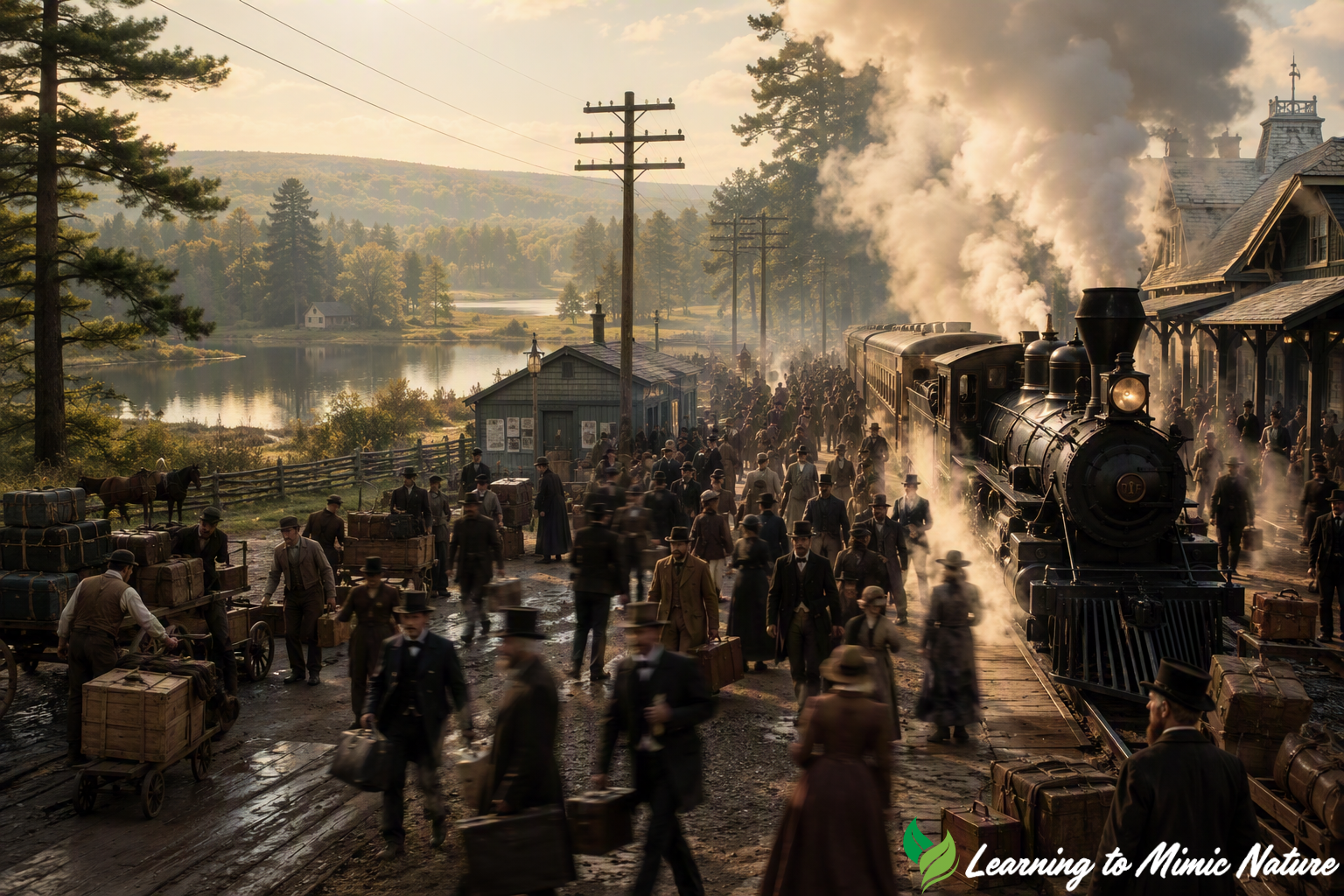
At first glance, this chapter appears to be about trains, noise, and industry. By the end, I realized Thoreau was asking a much deeper question: what kind of people do we become when the pace of progress begins to shape our lives?
Thoreau begins by describing the things he hears and sees at Walden Pond. Nature captivates him, and he remarks that he never ceases to be amused and entertained by the rhythm of the world around him. He also reflects on what the Eastern sages meant by “contemplation and the forsaking of works.” He understood that this did not mean avoiding responsibility, but rather stepping away from constant striving and learning how to be instead of constantly doing.
As the chapter unfolds, Thoreau observes the sounds that surround him: animals in the woods, carriages traveling distant roads, and the trains passing along the edge of the pond. He notices that the railroad is transforming more than towns and commerce; it is reshaping the entire countryside. The railroad created a new cultural value system that he calls “railroad fashion,” a way of living that prizes speed, precision, efficiency, and punctuality. Thoreau observed that people were beginning to speak faster, move faster, and live faster. The question that lingers beneath his observations is this: what happens when efficiency becomes more important than reflection?
To illustrate his concern, Thoreau references Atropos, the Greek Fate who cuts the thread of life. Her name signifies something unalterable, inflexible, and inevitable. In the railroad, Thoreau saw more than a machine. He saw a force that was permanently changing people, and through those changes, permanently changing society itself. People were beginning to surrender their pace to the pace of progress.
Yet as much as he observed the railroad, he also observed nature. One of the most striking moments in the chapter is when he describes the whippoorwills singing each evening with remarkable precision. Nature, he realized, has its own timetable. The train follows a schedule, but so do the birds. The difference is that the railroad is governed by efficiency, hurry, and commerce, while nature moves according to harmony, rhythm, and seasons.
Through these observations, Thoreau arrived at a simple but profound insight: a person can be orderly without becoming frantic.
Thoreau was not arguing against progress. Instead, he was urging people to pay attention to what progress was doing to them. The railroad taught people to admire speed, but the danger was never speed itself. The danger was forgetting that some of life’s most important work grows slowly. Wisdom takes time. Character takes time. Relationships take time. The deepest things in life cannot be rushed, no matter how fast the train travels.